I’ve been thinking about the history of religion recently and was inspired to do some research into it. I have never thought to answer this question, or even ask it, in my own mind before so it’s been an interesting journey. And not one I expected.
Anthropologists and archaeologists equate religion to when communities began to bury their dead. There is an element of survival in this insofar as it was sanitary to bury the dead, particularly if you weren’t as itinerant as you once were. It also stopped scavengers from mauling the body which hints at that sense of attachment to the body that we all feel when a loved one dies. But it also denotes that attitude of respect for the dead, both for the person and the body. A love that is clearly innate in us regardless of which period of history we exist within.
It is estimated that around 100,000 BC, in the middle Palaeolithic period, Neanderthals began to bury their dead with the earliest such discovery made in the Middle East. Whether there was this ritual beforehand is still open to debate amongst scholars, but it appears to be generally agreed that this represented some form of religious practice. Around 78,000 BC evidence has been found in East Africa of the burial of a Homo Sapien child with further Neanderthal burials dating to 70,000-35,000 BC found in Europe and the Middle East.
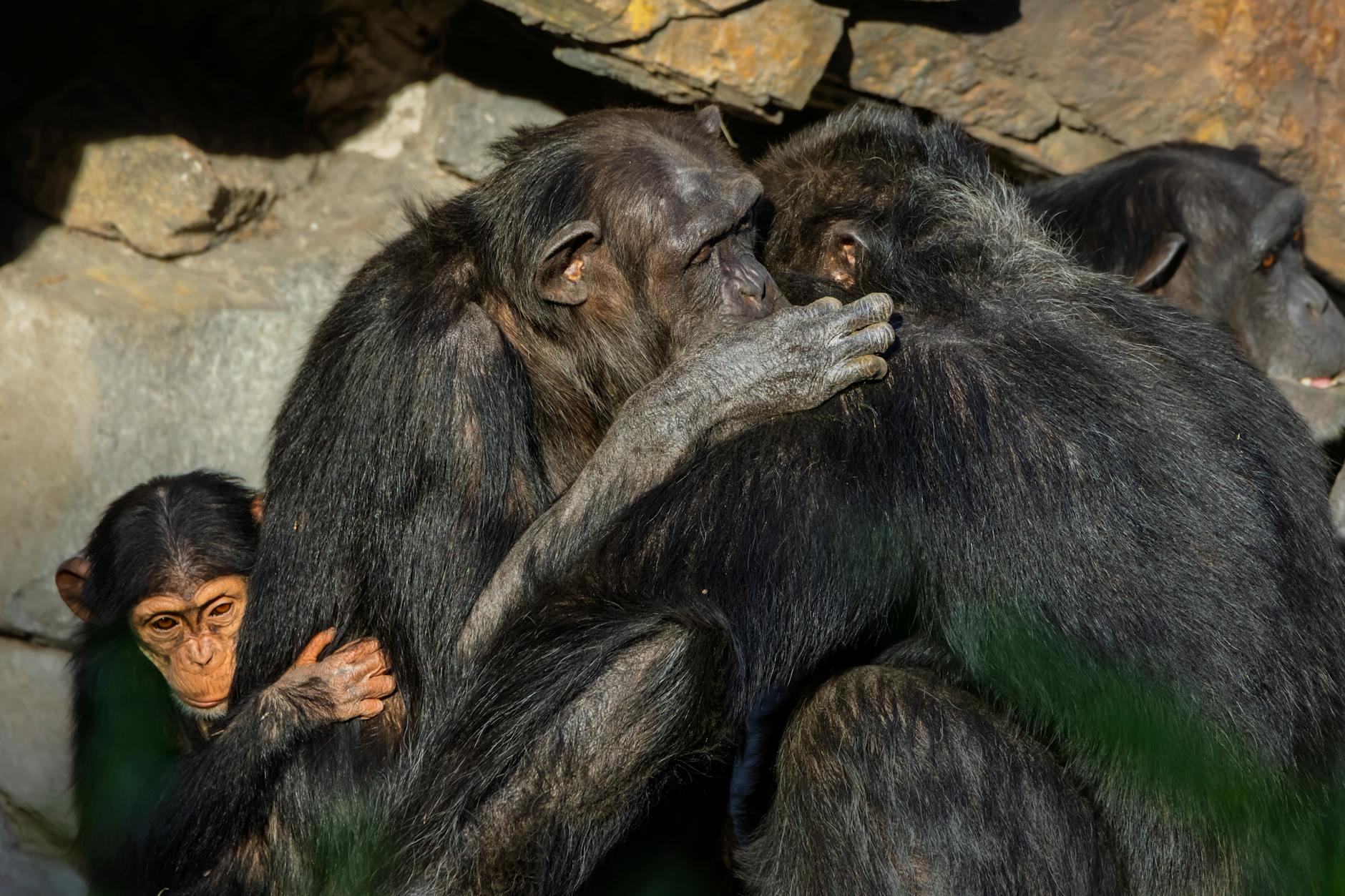
What is interesting when considering religion in the Palaeolithic period is the sense that early humanins did not have the ‘imagination’ for spirituality. That they did not have the ‘brain power’ for such behaviour. And yet…when observed after the death of a group member, both wild and captive chimpanzees display ritualistic behaviour. There is an initial, long, silence followed by distinctive vocal noise, grooming the corpse, visiting and gazing at the deceased, and clear noises of grief. Similarly, we know that African elephants in particular engage in ritualised practices at the death of a group member with Asian elephants also being known to bury their dead. Dolphins are known to stay with and protect their dead for days, and crows observe a ritualistic process around the corpse of a flock member which mimics funeral-type tendencies and mourning. But then, we seem to think we are the only creatures on earth capable of being sentient when it is quite clear to anyone with even a passing observation of all creatures and plants, they respond well to love. They know when they feel love and care as they respond, and animals most certainly return the sentiment. It is just our arrogance that makes us think we are somehow ‘more’ when it comes to this.
So, to my mind, these rituals are entirely plausible even before archaeology records deliberate burial. We know that the archaeological record is patchy by its very nature so we can’t assume we know everything about a period and the habits of those who lived during it.
As we are not the only sentient beings on this earth, I think we can wonder how other living things feel at the death of a group member whom they will have undoubtedly had emotions for. I have seen a dog grieve a beloved owner who has sadly passed. We know that farm animals have an attachment to the farmer. So, why can we not believe that they feel the same about their own kind? And do they, I wonder, question where that character, that essence that made them uniquely them goes after death? Or do they just know in a way we have lost?
Because I can’t help but wonder if early man wondered that. If early man looked up at the heavens – able to see them far more clearly than we can with all our light pollution – saw the Milky Way pass overhead every night, saw the moon and on occasion the other planets, saw all the trillions of stars, saw the shooting stars and maybe even the odd comet and think…what is that? What does all of that represent? What is the sun other than the warm light in the sky half the day? What provides the life that teems all around in its myriad of ways?
We know from indigenous hunter gatherer tribes that they are far more in tune with nature than we are. We know that they respond to the instincts of animals far more than we do. For example, when the Boxing Day tsunami hit over 20 years ago, it was feared an indigenous tribe had been wiped out but they had survived not by miracle, but by paying attention to nature and moving to higher ground with the animals. They were, in short, tapped into the collective conscious that we have ignored.
Our ancient ancestors would have been tapped into that collective consciousness also. They would have understood the land, the living things, the nature in ways we don’t begin to comprehend anymore. Consequently, I wonder if they therefore knew where the souls of their loved ones went to. If they had a mourning ritual like our even more ancient ancestors did (and still do in their modern form) that was also a celebration of their move into another plane. That perhaps they were far more spiritual than we are and than we give them credit for being.
That theirs was firmly anchored in nature, in life. In the creation of all the life around them and in that collective link between all of them. A spirituality that was based in nurturing and loving, based in the connection between all living things. That as we evolved we ascribed deities to this but the initial instances of spirituality were based in more earthly considerations. It’s not to say either is right or wrong, just that the differences began to emerge during the palaeolithic period with the findings of Venus-type figures carved by early man.
And I really can’t help but wonder…how did we evolve from that to where we are now. Where we are prepared to kill over religious differences. And how we possibly think we are more advanced as a result.

