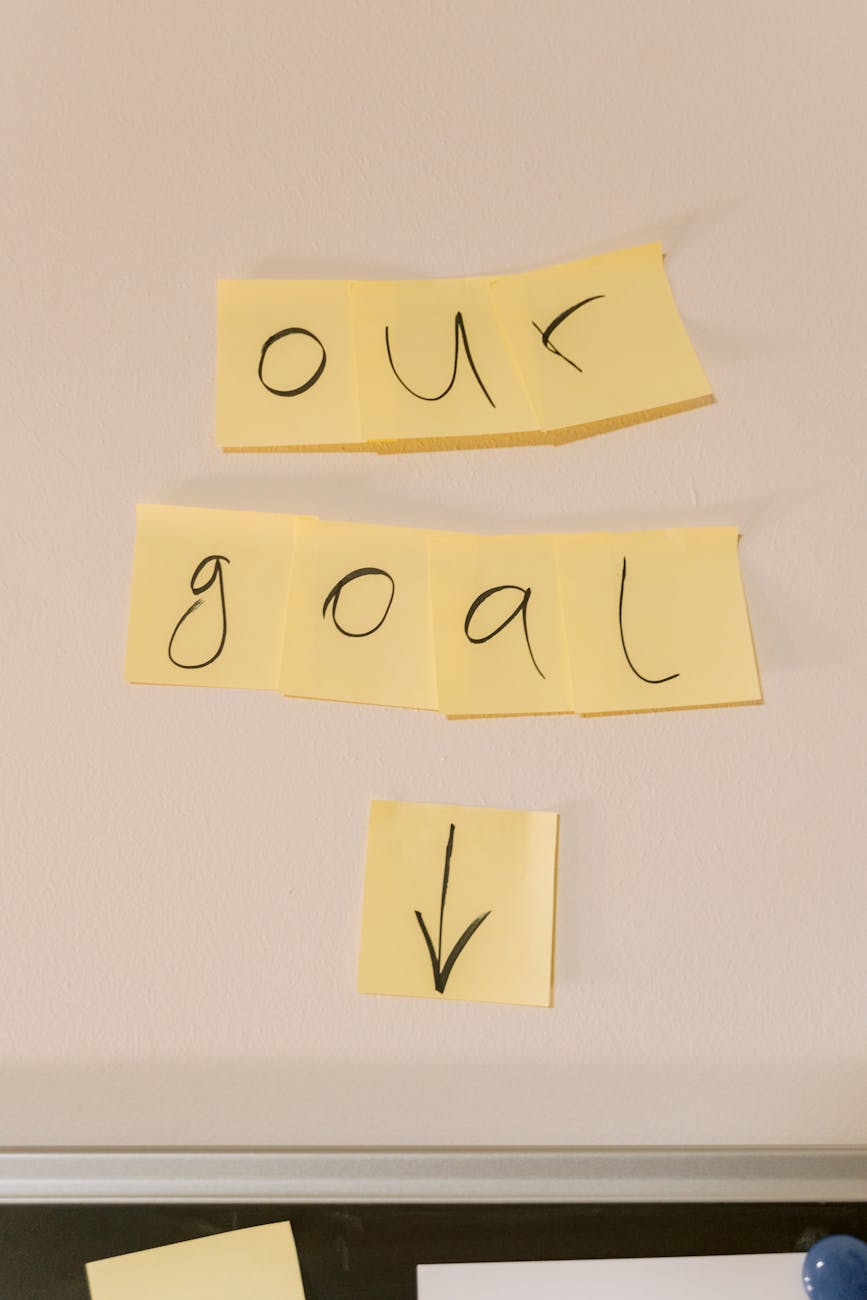
When we set goals and intentions, we always do so with the absolute best of intentions. It’s been well researched that if we set a goal and intention, we are more likely to achieve the outcome we desire than if we just coast along hoping for the best.
The first thing I would advise is to have a vision of what you want long-term. A goal/intention on its own is all very well but if it isn’t tied to anything, it will be more difficult to make it sustainable. For the simple reason once you’ve achieved it, if you don’t have the vision of the longer-term there is a stronger chance you will slip back into the ‘bad’ old ways.
It’s like if we want to lose weight if it isn’t tied to an overarching vision, it is less likely to be sustainable. Because once you’ve reached that target…what then? If, however, it is tied to a longer-term vision about being healthy, being fit, feeling a certain way for the long-term then you are able to break your vision down into a series of goals/intentions, the first of which is about reaching a weight/clothing size target. After that, you’re into maintenance. The vision itself doesn’t have to be precise and measurable (though it helps if it is), but it has to exist and has to be one you can sign up to. Because you need to train your mind to accept the new normal, particularly your subconscious mind.
Just thinking ‘I want to lose weight’ and expecting to follow a diet and exercise regimen is unlikely to cut it, though, for a number of reasons. The intention is there in that moment, but you haven’t geared your mind around what that really means. I also remember being told once by a coaching trainer that saying ‘I want to lose weight’ could be perceived as a negative because it is ingrained within us not to ‘lose’ anything. Which makes sense in a way. It was recommended that you set the goal as ‘I want to weigh x’ or ‘I want to be a dress size x’ instead.
That’s the important thing about setting a goal/intention, making sure what it is you are trying to achieve is measurable. ‘I want to lose weight’ could mean anything from a couple of pounds to, say, half your current body weight. It’s measurable in that you’re looking to weight less at some point in the future than you do now, but it equally isn’t measurable because how do you know you’ve have got to where you want to go to? As my old boss would say ‘what does success look like’? And you need to do more to articulate that to yourself.
The other important factor is how the language of the goal/intention is worded. Saying ‘I want to lose weight’ is, really, a wish. It might just scrape by as an intention but it is in no way a goal. “I want” is positive, yes, but it isn’t motivating. It isn’t action-oriented. It is just the same as thinking that the fairies sprinkling moondust on you will drop the weight off (newsflash – it won’t!). Even saying “I want to lose weight by eating healthy and exercising” isn’t a goal. Who doesn’t to an extent? You could just as easily say “I want to lose weight by eating McDonalds and sitting in front of the TV all day” as both will achieve the same thing. Nothing. Want doesn’t get as my mother used to say when I was a child. Want does not shift the dial on your Reticular Activating System (RAS) and it does not bother your subconscious programme in any way at all. No red flags going off there!
“I am” is the more motivating starting point for your goal and intention. “I am going to lose weight” is a step in the right direction. It’s far from being the finished article, but it’s moving in the right direction. It’s firm, it’s positive, and it’s more motivational and action-oriented. It starts to get your RAS and your subconscious waking up and taking notice. What is better is to state what you are going to do instead of what your aim is. So, “I am going to eat healthily and exercise to fit into size x clothes or to weigh x” – choose which one feels more motivating for you, clothes size or how much you want to weigh. Better yet is “I am going to eat healthily and workout 3 times a week/walk 45 minutes/start a running regimen (whichever floats your boat) to fit into size x clothes/to weigh x”. This shows that you have placed real thought and purpose into how you are going to achieve your goal which is now more measurable.
When it comes to food, I would not recommend saying “I am going to do the keto diet etc.” or “I am going to give up sugar and over-processed foods etc.” because you are introducing lack into your goal. In order to decide to give up carbohydrates, you have to think about carbohydrates. And the RAS, which doesn’t know negative, shows you more carbohydrates because you need to think about them to give them up. See what I mean? This is why diets do not work long-term. So, don’t start talking about giving anything up in order to lose weight because the moment you hit your target, your mind will say ‘okay, back on the cake now’. Don’t mention the word ‘diet’ at all. Eating healthily is a good target, especially if you don’t do so at the moment.
When you have achieved your goal/intention, you can then set the maintenance goal to achieve your overall vision. Whatever that looks like for you in order to sustain what you have achieved will become your next goal/intention.
When doing this, however, you have to be vigilant for your subconscious mind’s attempts to sabotage. If you have struggled with your weight your entire life, there is a strong likelihood that you are running a belief system that is keeping you overweight. You may have lost a lot of weight a few times in the past but then piled it back on again. That isn’t necessarily a lack of overall vision, that is a lack of understanding about how the subconscious mind is defining you. The programme it is running to make sure you return to where your comfort zone is. Establish whether your weight issues are due to a limiting belief or not. The limiting belief that you cannot be slim for whatever reason. Were you told at school that you were rubbish at Games lessons? Were you told as a child that you were ‘podgy’ that you had ‘baby weight’? These words find a way of burrowing under our skin and sticking in our subconscious, becoming a programme of belief that we run.
We do that by being conscious of this programme, of that voice in our head that tries to drag us back to our ‘old’ ways. You know the one, it says ‘oh, we can give the exercise a miss today’ or ‘just one wedge of cake won’t hurt’. We all know it, we’ve all heard it and we know the slippery slope it can take us on. Also reminding ourselves repeatedly that it is not our defining trait that we cannot be slim, we have proven in the past that we can be. It is also not our defining trait that we cannot exercise well, we will have disproven that in the past also. So, gathering the evidence that disproves the certainty our subconscious mind is trying to take us back to. And in that focus, our RAS will highlight all the ways in which we can achieve our goal/intention.
Just setting a goal/intention, whilst well-meaning, is often insufficient to fully achieve what we want. While research has shown that setting a goa/intention means we are more likely to succeed, it is how we go about that process that determines success or otherwise. If you would like help through to process of setting goals/intentions, please do not hesitate to contact me on hello@louisasimpson.com for an initial free conversation.
 Louisa Simpson