


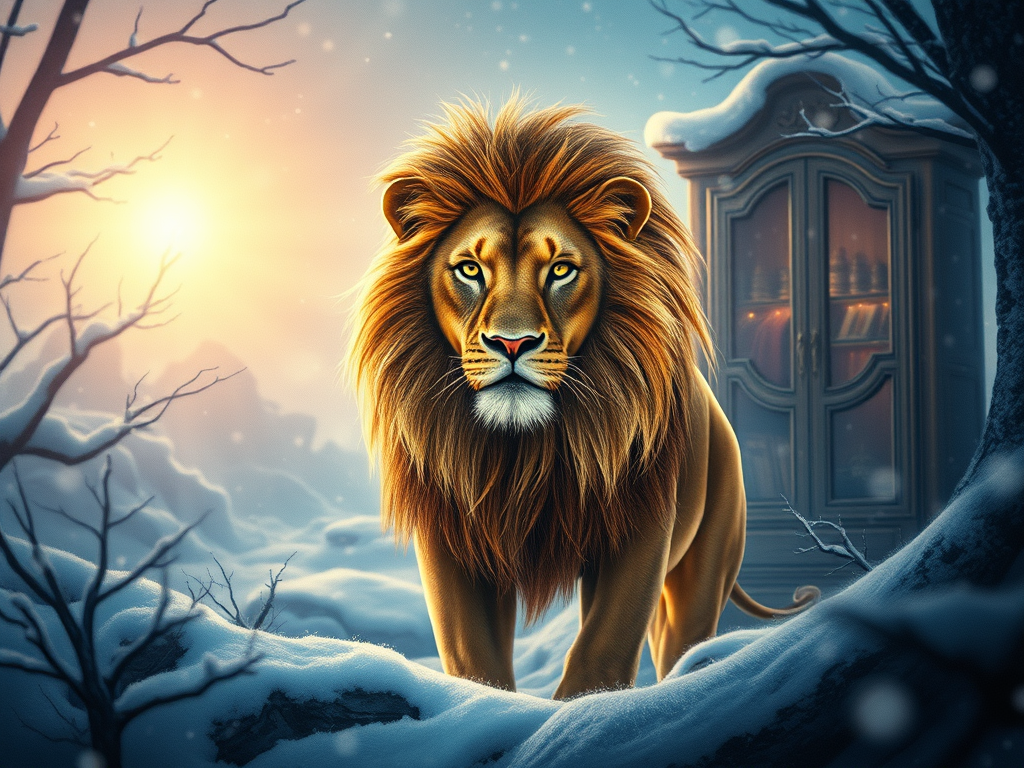
Without a shadow of a doubt, my favourite book as a child was The Lion, The Witch, and the Wardrobe. Yes, I loved the Heidi Chronicles but I barely remember what they are about. I also loved lots of other books at the time but, again, my memory of them doesn’t stand out. Except this book. I still remember the enchantment of it today.
What do I love about the book? I think, as children, we were all looking for that wardrobe in a way. That sense of adventure in a different land. One where we could be that adventurous without anyone telling us ‘no’. At the time I read the book, I certainly didn’t want to escape my life. I was probably about 7 when I first read it, and I just thought it was magical. The notion that you could walk through a wardrobe into a completely different world, one where the animals could speak, where even as a child you were fierce warriors, and despite the evil witch, everything just seemed marvellous, frankly.
It was a book where you could truly get lost in the fantasy of it all. The Heidi Chronicles was all well and good, but from what I do remember of it Heidi was a very good girl who admittedly had adventures and experiences, but beneath it all she was just a good girl. Rather bland, probably. Whereas in The Lion, The Witch, and The Wardrobe, Edmund was at least slightly grey morally considering he sided with the witch initially and didn’t have the greatest relationship with all his siblings. He was a bit tortured in trying to live up to his older brother who could do everything well in life. And I guess we can all relate to being the person who knows someone in their life who just is able, seemingly, to turn their hands at anything and do it with perfection and ease whilst never getting a hair out of place. The ones who seem to have the Midas Touch wherever they go, and feeling a bit…well, fed up about it frankly. It’s projection, obviously, because the truth is we all probably want to be a bit like that perception. Because that’s what it is, a perception. Peter wasn’t not full of insecurities, it wasn’t that he didn’t doubt himself, it was just that he kept a lot of that hidden until being in Narnia with all its dangers and needs, started to highlight them to his siblings. It was the same with the sisters, Lucy and Susan. Lucy was the one with her head in the sky whereas Susan was the sensible, practical one that Lucy resented in some ways because she felt Susan saw her as silly and annoying. And, yes, to an extent she probably did but only because Lucy was younger than her. And as teenagers, who didn’t think that younger children were silly and annoying.
Narnia is like an alternate universe, a place where all the norms in this world are turned upside down. Speaking animals who are fighting for their right to not be oppressed, led by Aslan the Lion who was quite possibly one of the most enigmatic characters. Yes, he was the good guy. Of course he was. But, he was much more powerful than he allowed himself to be. He could have defeated Jadis the Witch far earlier than he did. He had the support of all the animals around him, he likely didn’t really need the Pevensie children, but to me, he just didn’t deliver the killer blow as quickly as he could have. I know, there wouldn’t be a story otherwise, but there is something about the characterisation of Aslan that, to me, is more than just the ‘good guy’.
I know that many see the book as an allegory of the story of Jesus – that Aslan was sacrificed on the altar as Jesus was crucified on the cross, and was resurrected. That, though, doesn’t fit for me. Because Aslan is almost this ethereal figure whilst the witch is very present and very real. And gets her comeuppance in the end. No, for me, Aslan is an allegory for our soul. Like our souls, he is there providing guidance if we choose to listen to it, but he is content to stand back and watch others make their own choices and decisions in how they go about their tasks or destiny. He does offer sage words, but equally he sacrifices himself and has a period of silence when those sage words aren’t necessarily being adhered to. It’s only when he is gone is he truly missed, especially by all the Pevensie children. It was only after his death did they assume their full leadership role, but still they couldn’t quite manage without him, hence his resurrection. In our lives, this is the soul coming and speaking to us again, much more vociferously so we might have a better chance at victory in life.
For me, Jadis represents the worst of the egoic mind. That inherently negative aspect of us that is focused solely on survival. And which can tip over into greed, cruelty and manipulation. Jadis rules Narnia but is always looking over her shoulder for Aslan and the prophecy of the arrival of the Pevensie children. She isn’t secure in her control to the point where she is spiteful and cruel, even to her supporters. And she is always looking for external threats. She preys on the vulnerabilities of others, a bit like the subconscious mind’s limiting beliefs, and in so doing prevents Narnia from being all it could be. In fact, she is slowly destroying it. Jadis is holding the Narnians back, keeping them tethered to a land of perpetual winter, making it appear like a reality and rejecting the idea that there is anything else more powerful than she is.
Jadis is only defeated when Aslan returns and convinces the children, and the Narnians, to have belief in themselves. In their own power. To believe that they can defeat Jadis, that they are more than they think they are. That their belief can return Narnia to its former glory. Jesus never came to earth to defeat evil, but to spread the word of God to humanity and, in his crucifixion, to cleans it of its sins. Jesus, as I write in the Book of Sarah trilogy, was the human representation of a soul who spread the word that we are all connected to everything around us, that we are a part of nature as much as it is a part of us and that we are a part of the universe, or God, as much as the universe or God are a part of us. And that it is our egoic mind that is easily tempted into bad deeds which it dreams up on its own. Finally, in my allegory, Narnia represents humans – we have both Aslan and Jardis inside us, and the Narnians are our physical body, busy working away at keeping everything going and neglected to our detriment.
Clearly, I didn’t think any of this when reading this book as a child. Then, I was simply enchanted by the thought of being able to walk through the back of a wardrobe and into a new world. I remember being bitterly disappointed when I couldn’t find a wardrobe anywhere that would facilitate this. The author, CS Lewis, was born into a religious family but denounced all religion as a teenager until re-discovering his Anglican faith through his friendships with other authors such as JRR Tolkien, and it is likely that his faith influenced his writing. But equally, so did his great interest in Greek and Norse mythology as well as his reading of English and Irish fairytales. He was equally fascinated as child by Beatrix Potter’s writing which could have been an influence on him especially as, apparently, he and his brother invented a fantasy land called Boxen which was run and inhabited by animals, so I suspect that may have had a significant influence also.
The Lion, The Witch and The Wardrobe, is definitely a multi-faceted book, written by a brilliant mind. To me now, it is an allegory for humanity and spirituality. To me as a child, it was one of the most exciting books I ever read. And I love it to this day.
 Louisa Simpson