


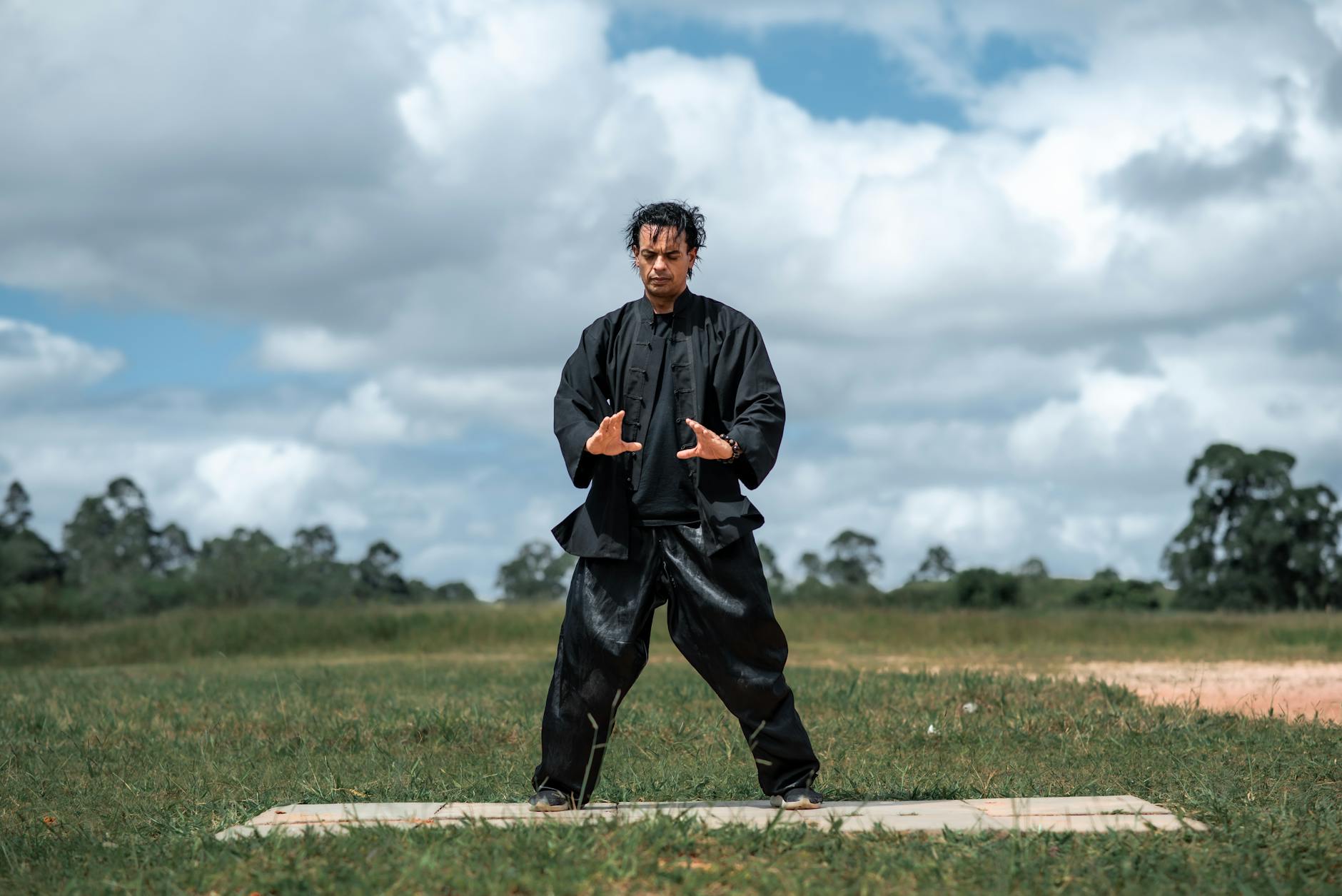
One small improvement I can make in my life is to adopt a habit of practicing qi gong every day.
I intermittently go through a qi gong routine in the morning but I don’t do it daily and I can go lengthy periods of time between ’bouts’ of undertaking it. It isn’t a fixture in my morning routine, and I think it’s about time it started to become one.
So, what is qi gong (pronounced ‘chee gong’), and why am I going to adopt it into my routine? It is, in essence, mindful movement aimed at balancing the qi, or energy, in our bodies. Removing negative qi and welcoming in positive qi. It isn’t difficult, there aren’t any contortions you need to wrap your body into, it is simply the easy movement, the flow, of the body through a routine that moves energy around your body. It is an ancient Chinese practice that also focuses on the breath, how it flows through the body and can help you with introducing breathwork into your daily routine.
It is brilliant for both mental and physical health because it provides you with that 10 or 15 minutes (or longer if you prefer) of gentle movement, breathwork and mindfulness. It helps to keep your joints supple, and in those minutes of mindfulness, it can quiet a ‘busy brain’. If you are feeling stressed or anxious, 10 or 15 minutes of qi gong will most definitely have you feeling better. You cannot help but relax in doing it. There is also some evidence to suggest that repeated practice of it can help cardiovascular disease, arthritis and osteoporosis.
My mother is ageing (she’s 78), and in typical Western fashion has in the past undertaken cardio-based exercise or some light weights but she has never done yoga or tai-chi. She is now getting to an age where she is starting to fall occasionally, and is realising that she has little to no flexibility in her joints now. They are stiff and painful and as a consequence, her falls when they happen are quite bad. Only last year, she cut her head open falling in the garden. To say that was worrying (I found her), was putting it mildly. She fell again last week, and I have teamed up with my step-dad to be quite insistent that she starts to practice either qi gong or Tai-Chi. It is a truth that, whilst elderly people in China and Japan do fall, it is far less common and when they do, they rarely seriously injure themselves. Simply because they are far more supple through daily exercises with qi gong and/or Tai-Chi. If we adopted it more in this country (UK), even funded by the NHS, the costs of nursing the elderly through falls would dramatically decrease. My friend’s father is 10 years older than my mother and has had, in the past six months, an average of one fall per week. He has been in a care home now for the past three months, but in that six month period, he has been in hospital for prolonged periods of time, three times. At enormous cost to the NHS and his own savings through the continuous care he needed whilst living at home, and now in the care home.
The mental health benefits of qi gong are well-known. For me, it is the flow of movement. The ease with which you move which requires, as I say, no difficult postures. I have a tricky shoulder as a result of surgery that required it to be repeatedly dislocated, and it cannot sustain repeated plank positions in pilates, and I do struggle with some of the yoga poses simply because I am not sufficiently flexible. I think if I was, I would not get injured so much with running. In fact, when I did do a gentle form of yoga, I found that my running improved exponentially. As always, though, life got in the way and I gave the yoga up. So, being able to gently flow through the movements of qi gong whilst being mindful of my breath is incredibly relaxing for me, and doesn’t aggravate old injuries. Knowing that I am shifting positive and negative energy in and out of my body, that I am rooted into the earth, is beautiful. It is a spiritual experience as well for me, and I am always smiling hugely when I have finished the exercise.
I have never practiced it in my garden, but now we are in spring here, I am going to start to do so (except when it’s raining!). In that way, I can feel firmly grounded into nature, feel myself being what I already am – a part of nature. There are plenty of YouTube videos to take you through a qi gong routine, and as I say, you need only do it for 10 or 15 minutes. Most of those videos are filmed outside, for a reason. For that grounding into nature and bringing that positive qi into your body. You don’t need trainers, you don’t need any sports gear on. Just do it in your PJs even. There is nothing needed except your phone/tablet/laptop and an internet connection. And I know, we can’t take those things for granted because not everyone has access to that. But if you are reading this, the chances are you do. And it is never to late to start this sort of practice.
So, I am going to start setting aside 30 minutes to myself each morning – 15 minutes qi gong, 15 minutes meditation. To set myself up in the most positive way every day. That is a small improvement I can make in my life that will have huge rewards.
 Louisa Simpson